Improving Telecom Network Energy Efficiency With Data Standardization
 Jon Baars
About Telecom Network Energy Efficiency Standards
The biggest obstacle to improvements in telecom network energy efficiency is the lack standardized network equipment and non-standard proprietary management interfaces. Telecom networks contain different site types, with each site type containing different ages, makes, and models of passive and active equipment. Lack of standardized data from this equipment prevents meaningful energy efficiency measurement and improvement.
A Method That Works With Your Existing Network
Solutions that create standardized data are less intrusive than solutions that require new hardware or deployment of new monolithic software. It isn’t realistic to replace existing equipment just to improve how it is managed. We recommend starting by just applying the method described here to see what standardized data can be created from your existing equipment.
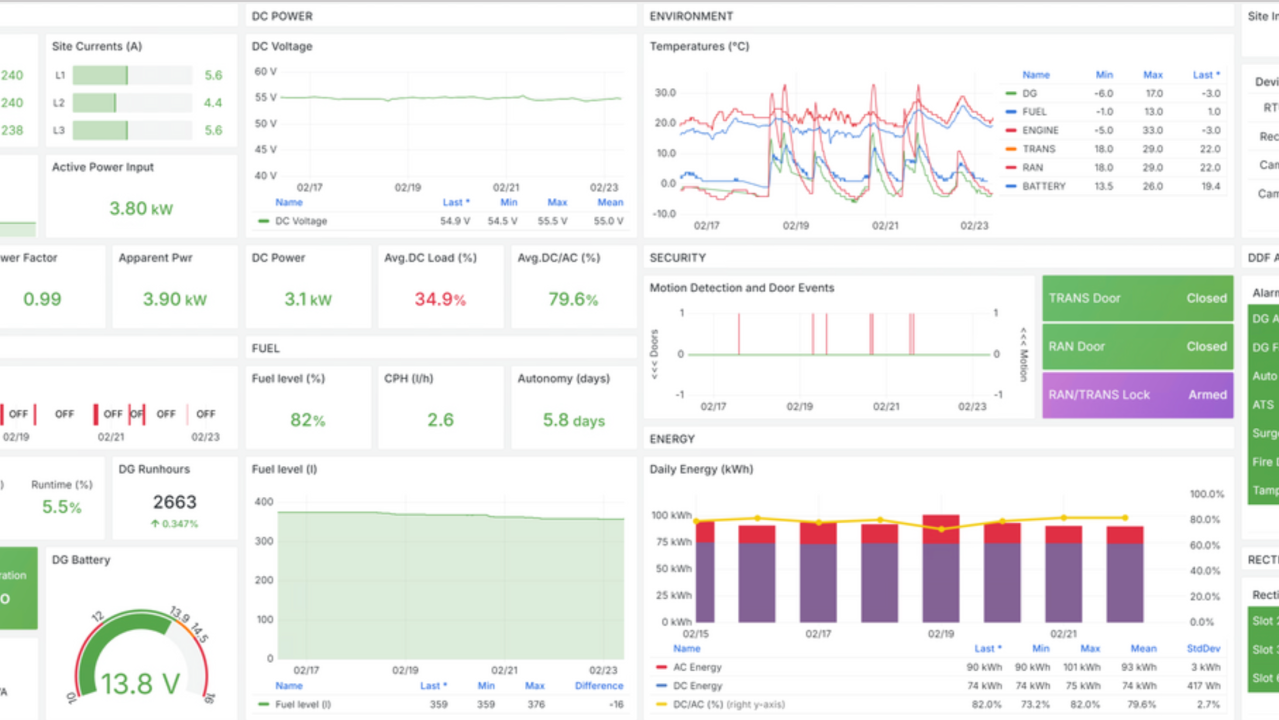
Cell sites, fiber repeater sites, or telecom central office sites are essentially miniature data centers in terms of energy use. You can collect 25–100 (depends on your network equipment) standardized energy-related telemetry parameters from many classes of equipment - DC plant, batteries, generators, HVAC systems, AC or DC meters, RRU’s, existing RTU/IoT solutions, and even IP cameras. Data is retrieved every few minutes across thousands of diverse telecom sites, with data from all equipment classes converted to open standards.
This method is in use in multiple projects now using common and powerful open-source tools, with years of standardized historical data created. It is a mature solution/method that exists today that every telecom operator should be adopting.
A solution based on standardized data is:
· Better
· Achieved Rapidly
· Less Expensive – Immediate ROI
· Less Risky – Non-Proprietary
· Suited for use with AI
Standardized Data
Allows you to:
Compare - Compare all sites, regardless of the equipment make or model. It is possible to get basic power usage effectiveness (PUE) measurements from every cell site in near real-time, just as is done in data centers today. Network dashboards identify poorly performing sites instantly and individual site dashboards give rich data to troubleshoot problem sites.
Control – The method of standardizing data can also be used “in reverse” — to send control commands to different makes of equipment (e.g. exercise generators, change HVAC set points, cycle batteries), regardless of vendor and requiring no addition or replacement of site equipment. This creates a closed loop system where you can make a change, see the resulting data, make another change, and see another result. Perfectly suited for upcoming AI advances.
What can you gain from real, standardized data?
By measuring live, standardized energy data from every site, you can save .5 to 1% of total network energy use simply by detecting and fixing poor-performing outlier sites even in relatively efficient networks. We often find once we have standardized measurements from sites that large numbers of sites are not performing very efficiently compared to existing standards. The resulting data also gives direct measurements for all your other energy efficiency initiatives, particularly the use of different radio vendor’s power-saving features (RRU PSF). Using the control functions described above, even more savings are possible with applications changing HVAC set points or cycling lithium-ion batteries.
A Method Instead of a Product
Our approach relies on open-source tools and requires no initial hardware or software changes. This method is simply added to your network without disturbing your current processes. We believe you can get a lot of value out of every step we list below. The value doesn’t just arrive in the distant future when a project is complete but arrives at each step of the way.
- Learn from real data:Whatever your current energy efficiency goals are, we really recommend you have a look at the data we’ve already collected and talk to us about the method we use.
- Start small: With a small engagement, we can set up a pilot system for 5–10 sites — a valuable sandbox for testing other energy-saving efforts, seeing real-time results, and getting real-world, living benchmark sites. Even if you never expand the solution further, even a small trial is a valuable tool.
- Scale up: Once the trial is operational scaling up is fast. Run one region with the system and compare results to regions without it. Without having to install devices at sites and using tools designed to scale both horizontally and vertically, this solution can be deployed across large parts of your network very quickly.
We encourage anyone with interest in telecom network energy efficiency to give us a call and have a discussion.